Showing posts with label Todd James Pierce. Show all posts

Monday, November 10, 2025

Between Books - Marking Mary Poppins


Cover for Making Mary Popping book, with an umbrella on a field of golden yellow.


As someone who has loved past books by Todd James Pierce and listens to his Disney History Institute podcast weekly, I get pretty excited about any new books or articles he publishes. Having heard some of the material from his latest book in a multi-episode podcast, I was a little worried that his new book would not seem fresh to me. I am happy to report that this anxiety was needless.

Making Mary Poppins: The Sherman Brothers, Walt Disney, and the Creation of the Classic Film by Todd James Pierce provides an engaging and well-researched history of the film. The film’s story is not seen through the life of Walt Disney or Pamela Travers, but instead through the lives of his boys, Richard and Robert Sherman. Pierce begins and ends his story with the brothers, their father Al’s career as a professional songwriter, and the experiences that shaped two very different personalities. It was Al who saw the potential of his two adult sons and songwriting. One son, Robert (or Bob), was a World War II veteran who wanted to write novels. His other son, Richard (or Dick), was a young father and divorcee who dreamed of writing musical theater. With his introvert son Bob and his extrovert son Dick struggling to establish careers, Al challenged them to write a song together that an artist would be willing to purchase. After some early false starts, in 1958 their song “Tall Paul”, recorded by Annette Funicello, would become a hit!

Their continued collaboration with Funicello would garner the attention of Walt Disney Studios. The two met with Walt Disney to discuss potential work on the television show Zorro. But Disney’s focus was on a song that could be used in a future movie that would become The Parent Trap. This led to another meeting, and another assignment, and another meeting…until eventually the Brothers were hired full-time as studio songwriters, contributing to numerous projects across the studio. One of those projects was to provide potential songs for a movie based on Travers’ Mary Poppins, a book lacking a sequential plot fit for a movie. The two brothers would spend the next few years working and reworking songs, and help develop the plot of the film as it entered production. Pierce deviates from the brothers with the film in production as he turns his focus to other artists who worked on all aspects of the film. The book finishes with the successful premiere of the film, a night where young fans looking for stars labeled the two men as nobodies, invisible despite the enormous contributions they made in shepherding the story through music.

I had experienced some of this material in audio form on the Disney History Institute podcast. I enjoyed the storytelling in that format. But I worried that in book form it would feel like material that I had all heard before. However, that was not the case. Even without Pierce narrating the tale, I was still able to pull myself into this story. The Sherman Brothers and their often differing personalities are two characters that you want to cheer on as a reader, so while some of the story has been told before to me, on the page, I was still pulled in. Making Mary Poppins is one of those books that is a joy to read and engage with. It is both well-written and researched. The volume is also accessible for those who are tone deaf, like me! Often, I felt like I was reading the book that inspired Saving Mr. Banks, giving the audience the real story… although the movie was released years ago.

One of the aspects of the book that really stood out to me was the struggle. As a fan who largely knows of the Sherman Brothers well after they reached Disney Legend status, it is hard to imagine that they were not instant successes. In fact, their father may have seen them as grown adults without purpose. He was the parent of two men who were living together, only out of familial connections, and hitting rough patches in their lives. Even after he put them on a path to future success, they still were not instant successes despite Al’s career. The two had false starts on major recordings, had a somewhat unsuccessful publishing business, and had to work other jobs, including Bob as a flower arrangement instructor. This is a story not of overnight successes, but one could argue the American story of hard work and effort. It is a story that makes them even more relatable.

Making Mary Poppins: The Sherman Brothers, Walt Disney, and the Creation of the Classic Film by Todd James Pierce is easily one of my five favorite new Between Books of 2025. Pierce has again written an accessible and engaging story, built around the two figures who had in my opinion the most creative impact on Mary Poppins with little of the credit. Even those who have heard Pierce’s earlier audio-only version of some of this material will still find it feels fresh! It is a volume that only helps you feel even more admiration for Robert and Richard Sherman. 


Review Copy Provided for Review

This post contains affiliate links, which means that Between Disney receives a percentage of sales purchased through links on this site


Monday, September 2, 2019

Between Books - 2019 Hyperion Historical Alliance Annual


The Hyperion Historical Alliance is a relatively new to the public association with a charge for professional historians to preserve Disney historical documents, artwork and materials. Additionally members will continue to grow Disney scholarship both through an annual and the support in publishing historical monographs. While the group has been in existence since 2009, it is only now in 2019 that the scholarship publications have moved the group into the public eye. And with a membership that includes Didier Ghez, Todd James Pierce and J.B. Kaufman among others, to me the promise of this group and truly professional Disney history seems promising.

The “2019 Hyperion Historical Alliance Annual” is really the first public facing effort of the Alliance. The publication serves as a true professional journal publication, helping to move forward the concept of professional Disney history. The journey fills a niche found in other historical societies by allowing members to provide the community professionally researched and written short articles on Disney history topics. And the publication truly feels like a professional journal with serious historical scholarship. Perhaps the only things missing are book reviews, calls for papers and membership opportunities (which is not available at this time.)

The “2019 Hyperion Historical Alliance Annual” offers six articles. The topics range from profiles of former Disney employees who are generally not known in the Disney community, two articles on Ward Kimball, and The Little Mermaid. The topics establish that the Alliance covers numerous decades of Disney history. The articles are all generally written as one would expect a historical journal article, professional, lacking a fan voice and relying heavily on primary sources many of which are not available to the general public. And overall, the authors succeed in providing a professional historical journal complete in tone and style.

Content wise, I really enjoyed “Jack Cutting, an Artist Abroad” by Jim Hollifield. The article did an excellent job of capturing the life of Cutting from artist to Disney executive working with international markets. Cutting served as an employee who could unite the Walt and Roy sides of the company. But perhaps what struck me the most is how examining one individual can show us historical trends at large. This lesson was most highlighted for me in Past Time by Jules Tygiel. While this monograph is focused on baseball, it demonstrates important immigration and industrialization trends in American history. The Cutting article demonstrates how corporate America functioned in a post-World War II environment and the growth of international markets for American businesses.

Sadly, the article I would have liked to see excluded is one of the best written, “Ward Kimball and the Making of Snow White and the Seven Dwarfs” by Todd James Pierce. I really enjoy Pierce’s written. But much of this content is already available in The Life and Times of Ward Kimball, an excellent monograph. Additionally, Pierce also adapted this content in an audio form as a podcast. And his work is so successful, I actually read the article hearing his voice including pauses and inflection. But I would have really enjoyed new content from this excellent historian, as I believe the audience for the annual may have likely read the Kimball book already like I have.

As someone with two history degrees I really support the idea of professional Disney history. And I plan to look into the both the monographs and future annuals. If anything I would ask right now is how can I support this effort? Membership at the moment is closed to the association. And there are no casual or supporter memberships. I am fully prepared to purchase the future offerings. But I do wonder if in the future there could be membership options like The Society of Baseball Research, which would offer merchandise or provide avenues for publication. Because the “2019 Hyperion Historical Alliance Annual” makes me hopeful for future of professional Disney history along with a desire to help.


Sunday, March 12, 2017

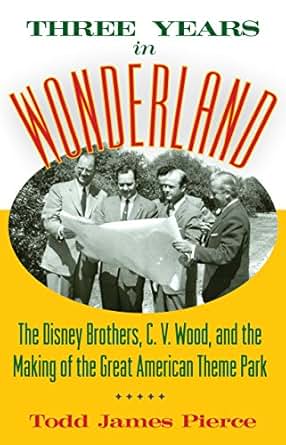
Between Books - Three Years In Wonderland

51QtrdGB3pL._SY445_QL70_.jpg (286×445)

The Disney History Podcast did its job.  I bought the book!  Yep, I could not resist as I binged Todd James Pierce's audio segments.  But would the book fill the Disney history itch I wanted scratched?

Three Years in Wonderland: The Disney Brothers, C.V. Wood, and the Making of the Great American Theme Park by Todd James Pierce details the creation of America's first cinematic theme park, Disneyland, from the perspectives of the park's first General Manager C.V. Wood and Walt Disney.  We know from the beginning of the book that the Wood - Disney relationship is doomed to fail, though Disneyland would be a success.  Pierce provides readers biography of the wild yet charismatic Wood and his unlikely journey to Stanford Research Institute (SRI) and his early work with the Disney brothers.  Pierce adds information about Walt Disney's dream for a theme park and the efforts, especially financial, to get his theme park built. Pierce then narrates the construction of the park, including the attempts by Wood to bring his inner circle into the park management and perhaps enriching himself.  Finally, as the park survives its opening, the author outlines how Wood's relationship with Walt Disney soured, or perhaps never was amicable.  Overall, Pierce helps highlight in a way an official Disney book cannot and will not, Wood's contributions to the building of Disneyland.

I think it is a good sign.  I loved this book, but there is more I wanted from it.  First, I wanted more about C.V. Wood and his private life.  In the narrative, Wood is working in the aircraft industry and then we meet him again at SRI.  I would love to know more about how Wood changed industries.  Second, Pierce tells us that his habit of being a workaholic was an issue for his marriage.  Yet, Pierce discusses mostly Wood at work or play really only with his inner Texas circle, the Bombers.  I would love to hear more about his personal family life during his Disney years.  But perhaps there is no documentation of this period.

Three Years in Wonderland is entertaining and educational.  On the entertainment front, Pierce uses poetic license and flourish at times to make this history feel dramatic and very far from dry.  In the educational side, it really is Wood we learn quite a bit about.  Pierce reinforces that Walt Disney was the most supportive of his creative staff.  And Pierce places Wood within the financial circle of Roy Disney.  It becomes clear that Wood was not a Walt Disney favorite, but instead someone that was necessary not beloved.  And Wood did not cross easily into Walt Disney's circle like Admiral Joe Fowler who seemed to straddle the Walt-Roy division within Disney staff.  In many ways it becomes clear that the charming Wood was destined to leave Disney employment when he was no longer needed to help sell and build Disneyland.

Three Years in Wonderland is must read for Disneyland fans.  It is part soap opera, part history as experienced readers who have glances over Wood's names numerous times learn more about this enigmatic and invisible Disney, no not legend, myth.  In the end, the book scratched my Disney history itch and drove me to want to know more about wood.  Hint, hint...I would love a sequel that discussed Wood's post Disney parks and developments!


Sunday, February 26, 2017

Dreaming Disney - Disney History Institute Podcast


If you are a Disney fan, it is a must. If you are a theme parks fan, it is a must. If you are a history fan, it is a must. If you are a story fan, it is a must. If you like to hear about creatives, it is a must.

What am I talking about?

I am talking about the podcast I have always wanted and did not know existed for over three years.

My newest podcast recommendation to everyone is the Disney History Institute Podcast. And when I say everyone, I mean everyone. I have gotten friends who do not like Disney to binge episodes because the stories and production are just that good!

Disney History Institute Podcast by Todd J. Peirce is predominantly audio versions of Peirce’s articles from the Disney History Institute website. Along with Peirce’s well written articles is quality production with supporting audio beds and Peirce’s voice that helps pull you into a story. I have experimented a bit with scripted podcast episodes, and it is not as easy as it seems. But this podcast combines quality content with strong production values. It is convincing enough that I had to buy his book!

The content is basically audio presentations of Peirce's articles. I will be honest, though they have been available in text form, I have not read them. These articles are somewhat big at times and I do not have the time to sit online and read these articles in depth (yeah it is kind of ironic with this being a blog and all). So this audio presentation has given these articles a second life. But the best part is you really do feel like you are getting pulled into a story with Peirce serving as the storyteller. The topics fascinate me with me telling everyone to go listen to “The Bible Storyland Fiasco” immediately. I love this history which balances defects in personalities with the humorous thoughts of a Jungle Cruise Garden of Eden ride completely with sexism. The Disney fan will be drawn to the multipart expose on the Yippie Invasion, the infamous Studio field day, and glimpses into Walt Disney’s life. I will admit, after hearing his piece on Ruth Shellhorn I find myself kicking myself for not knowing more of her Disney story. Additionally, along with his articles, Pierce shares interview audio of Disney legends like Harriet Burns, Blaine Gibson, and Jack Lindquist.

The only real complaint is frequency. The episodes post when Peirce has one ready. So it is possible for long gaps. But it is good free content. A friend did point out to me that “Walt’s First Park Part 1” was never followed by a Part 2. But I found myself arguing, but buddy it’s free. My friend did go online to read the second part of the story.

Disney History Institute Podcast by Todd J. Peirce is my new favorite podcast I did not know existed. If you are a Disney fan, you need to subscribe now so when a new episode drops it is pushed to you. Because you will both learn and be entertained by this audio presentation.

Monday, September 14, 2015

Between Books - It's a Crazy Business


It's a Crazy Business: The Goofy Life of a Disney Legend by Pinto Colvig and edited by Todd James Pierce recalls memories of the Disney studio from over 70 years ago.  Colvig, a Disney Legend perhaps not familiar to many of us, worked as a story artist along with being the voice of Pluto.  Colvig in fact made a career for himself as a sound man, voicing not just Pluto but providing a variety of sound effects on radio and theatrical releases. 

Colvig's memoir written in the 1940s recalls a number of Disney and non-Disney events.  He discusses how he came to Hollywood after being a second, or third rate, member of a traveling band.  Colvig actually started as an animator, experimenting with his craft in live-action and even running his own studio briefly.  And he details how he discovered some of the sounds he used in productions and how they were delivered in radio.  Colvig examines the Disney operation from his days including discussions of Disney story meetings and the voice actors that he worked with at the studio.  He finishes with a very personal look into his life, a nervous breakdown that he suffered while working on Snow White and the Seven Dwarfs, providing the voices of Grumpy, Sleepy and more.  His description of the incident includes him acting out in the office and follows with a detailed discussion of his days in a sanitarium.  

It's a Crazy Business feels very homespun.  Colvig's style is to write to the reader as if a conversation is occurring.  So one feels like you are sitting at times in an intimate room as he tells you about that one time, or let me tell you about this gal I worked with.  It is intimate, friendly, honest and folksy.  And when we say honest, this includes his experiences with visions while coalescing in the sanitarium.  He really pulls nothing back as he tells his story.  It is quirky and funny.  His closing chapters do demonstrate how stressful it was for even animation veterans when making Disney's first feature length cartoon.  Additionally, Colvig does give one a flavor of the Disney studio during the 1930s including the people who worked with him.  

It's a Crazy Business introduces Disney fans to Pinto Colvig, a legend that you likely you did not know beyond trivia.  Nobility and statesman visited the Disney studio just to hear him bark, as Pluto.  And some hoped to be like him, making noises with his half of a trombone.  But in the end Colvig proves himself to be an original that others cannot copy with both his personality and ingenuity.  

Review Copy Provided by Theme Park Press