Showing posts with label Didier Ghez. Show all posts

Wednesday, January 22, 2025

Between Books - Walt Disney & El Grupo in Latin America

Book cover for Walt Disney and El Grupo in Latin America showing South America and a suitcase with hotel stickers.


I’m tired! I think Walt Disney may have been tired too!

Walt Disney & El Grupo in Latin America by Theodore Thomas, J.B. Kaufman, and Didier Ghez outlines Walt Disney’s trip to South America in 1941. The book covers the entirety of the nearly 3-month fall expedition, spreading American goodwill as a strategy to win over South American neighbors away from Nazi sympathy. Disney was asked by the Coordinator of Inter-American Affairs (CIAA) to use his global celebrity to strengthen Western hemisphere ties. The story is told heavily in images with the authors providing narration to the group’s daily doings. The volume does not focus on just Walt Disney but recognizes that El Grupo the 18 Walt Disney employees and family members on the journey, were at times separated into smaller traveling parties or even in the same cities separated to meet with numerous local industries or celebrities. Due to the highly visual nature of the text, it at times feels like a documentary and less than a book.

I’m tired, did I mention that? The goal of the authors is to provide a detailed account of the trip. The trio, therefore, doesn’t provide us a thesis to prove, in fact, the three have other works on El Grupo that have this as a goal. As a reader, you understand this is a very visual book seeking to provide a daily accounting. Hence, I’m tired. It feels like the group, especially Disney, rarely had a chance to rest during this fact-finding and goodwill-building adventure. Even in “downtime” artists like Mary and Lee Blair and Jack Ryman were sketching, painting, and refining ideas for potential future movies Saludos Amigos and The Three Caballeros. Or perhaps, Jack Cutting may visit a local studio to supervise a movie dubbing into Spanish. The book makes it clear that this group of 18 were constantly in motion. And while early in the trip, they may have spent in the reader's mind “weeks” in Rio, it becomes clear to the reader that on later stays the group seemed to only linger a day or two in a location before moving on again.

Design-wise, I was pulled into the book and it often felt like a visual experience and not a book. That is why I feel tired. This isn’t an era of perfect staged pictures. The spontaneous nature of many of the pictures helps one to feel the emotion and action, like a tired Lillian Disney asleep on a train car one can feel the stuffiness within. The closed eyes and the improperly directed glances remind us this is a different time before everyone had a camera and the time to coordinate numerous shots for the perfect social media image.

My only complaint with the design is some pages have maps on the layout that pictures and text sit upon. These maps have notations to locations on the page design. Sadly at times, I read these like image captions and not part of the page design which took me out of the journey for a bit.

Walt Disney & El Grupo in Latin America by Theodore Thomas, J.B. Kaufman, and Didier Ghez is a book for those who want to go deeper into Disney’s trip to South America in a highly visual way. For those who want to see Disney legends like the Blairs and Frank Thomas working, drawing, and immersing themselves into a culture this offering is for you. The authors help me to understand the kinetic and tiring nature of the trip, even without making this an overt goal. I wondered, can El Grupo just kick back and relax? An answer that seems like no as Frank Thomas was teaching himself Spanish even on the long-trip home.


Quick Note: While you can purchase this text on Amazon. I grabbed mine at Stuart Ng books where I was able to pick up an autographed copy


This post contains affiliate links, which means that Between Disney receives a percentage of sales purchased through links on this site

Monday, September 23, 2024

Between Books - The Origins of Walt Disney’s True-Life Adventures


Book cover for The Origins of Walt Disney's True-Life Adventures showing  the True-Life logo of a compass with the film series title.


I feel like Walt Disney’s True-Life Adventures is under-represented within Disney fandom. The films are not available on Disney+. It feels to me like they are only really mentioned in some publicity for the yearly Disney Nature feature offering. We need to squint to connect some intellectual property in the parks. Yet telling the stories of nature has historically been a long-existing theme for the Walt Disney Company as seen in the mentioned Disney Nature brand and an entire theme park in Disney’s Animal Kingdom.

The Origins of Walt Disney’s True-Life Adventures by Didier Ghez, the second volume of the film monograph series of the Hyperion Historical Alliance, dives deep into the origins of this Disney theme, beginning as early as the development of Bambi. Ghez addresses head-on the myth that the True-Life Adventures and the release of the first short in 1948, Seal Island, started with a brief interaction between Walt Disney and Disney Legend Cinematographer Alfred Milotte. Instead, we start in the 1930s with the production of the 1942 animated forest feature. Artist Maurice “Jake” Day was charged with capturing live-action references and images from his native Maine. Day’s trips into the wild, provided reference that helped Disney executives begin to see the possibilities of nature documentaries. With production in the early 1940s focused heavily on educational films during World War II, this interest continued as the studio attempted to find ways to monetize the educational market. This exploration would lead to Alfred Milotte and his wife, assistant, and fellow Disney Legend Elma Milotte being contracted to film material in Alaska in 1943.

Ghez provides us with an in-depth view of the Milottes in their production process in Alaska, brilliantly weaving together his own narrative with original journals and letters. The reader follows the pair as they learn to film to Hollywood standards and struggle with practices like using a slate in atypical conditions. The pages, and images, help us watch the two grow as they explore a world that for much of the 1940s was a true frontier for most Americans, with some of them seeming familiar to us who today catch episodes of The Deadliest Catch. Ghez chronicles for us how those at the studio viewed the filmed material and struggled with determining how to use the hours of unedited reels the duo in the field created. The final decision was to focus on one shorter segment, not long enough for a feature but an adequate story for a theatrical short. The book concludes with the production of additional True-Life Adventures and their legacy. An appendix provides the reader with the credits of the True-Life Adventures series.

It is a very well-written and engaging book. You at times feel like you have joined some of these expeditions and share in their logistical hurdles. How will we get to that remote island the reader asks, throwing themselves into the wilderness journey. I also found myself sympathizing with the Milottes as they read the criticisms of production supervisor Ben Sharpsteen. As Sharpsteen wrote, safely and warmly from California, Ghez’s writing can place us in the Milottes’ shoes as they are just trying to get to their far-flung locations while the studio is worried about angles, coverage, and proper use of slates (which of course did not work well in frigid temperatures). Ghez is able to get us here through his well-placed reproduced primary sources where through journal or letter the participants in their own words bring us back in time while using his added narration to set scenes and provide transitions.

Another strength of the book is the well-placed use of illustrations and images. The Hyperion Historical Alliance prides itself in not just narrative history, but sharing visual artifacts. Therefore there are several still pictures, archival illustrations, and even pages of storyboards that help the reader to better immerse themselves into the subject. The total package of words and images shows a high value to editorial skills for the finished text.

The book is very origins-heavy, which makes sense as that’s what the title promises! One may ask for additional information about what happened next in more detail. But that feels like a potential follow-up and not a piece that has to fall within the scope of this title as it is not meant to be a comprehensive history.

The Origins of Walt Disney’s True-Life Adventures by Didier Ghez is an excellent and engaging book on what is often a forgotten Disney live-action endeavor. Ghez’s words and pictures pull us into a story, one that is part studio history and part adventure tale. It also helps us to better see the story of the Milottes up close where we can see their contributions to film history.


Addendum: While text is available on Amazon, I purchased my copy at Stuart Ng Books website which offered an autographed copy. Additionally, other autographed Hyperion Historical Alliance publications were available there online.


This post contains affiliate links, which means that Between Disney receives a percentage of sales purchased through links on this site.  

Tuesday, May 14, 2024

Between Books – Hyperion Historical Alliance Annual 2023


Cover for 2023 Hyperion Historical Alliance Annual showing the contents and images of subjects in the collection like Woolie Reitherman in a military pilot's uniform and Pete Seanoa in Polynesian clothing.


New year, same review?


I feel like I restate the same thoughts whenever I read the latest Hyperion Historical Alliance annual.

Maybe it’s because I feel “excluded” and I don’t like that. I’d like to think I’m pretty serious when it comes to history.

The “2023 Hyperion Historical Alliance Annual” consists of five articles that span decades of Disney history from the early days of animation to the 1900’s in Disney parks. The five articles are:
  • “Oswald the Laemmle Rabbit” by Tom Klein

  • “Walt Disney and The Life of Hans Christian Anderson” by Didier Ghez

  • “Woolie Reitherman Needs to Fly” A Disney Artist Goes to War” by Lucas O. Seastrom

  • “1945-1946: Edgar Bergan and Disney’s Story Department” by Didier Ghez

  • “Direct from the Islands: The Polynesian Magic of Pete Seanoa” by Nathan Eick


The articles are all written with an academic slant. And they have extensive footnotes with bibliographies showing source material. They definitely as a group are attempting to show the seriousness of Disney history.

For me, the most engaging topics were Oswald and Woolie Reitherman. Klein’s article demonstrated that the creation of Oswald the Lucky Rabbit was not fully in the mind of Walt Disney. In many ways, Oswald was a corporate creation, which reminded me of the modern studio and network system where executives, producers, and writers all have claim to pieces of the character. Disney’s additions were critical, providing Oswald with much of his character development and growth. But Klein makes it clearer that the Lucky Rabbit was a corporate rabbit not a Disney one. We might even call Oswald work-for-hire. The Reitherman article dives deep into the artist’s non-animation career as a military and civilian pilot. The article helps remind us of how the Greatest Generation was often more than one thing and career, which should inspire us! But it is also a history that includes World War II, transportation over The Hump into China, and the growth of commercial air travel.

The “2023 Hyperion Historical Alliance Annual” to me has an audience, Disney fans who want serious historical research. They want their passion to be validated as a serious academic pursuit. I also think these fans, like me, would love to support the Hyperion Historical Alliance in their mission. In fact, my proof is the purchase, reading, and review of now four Annuals. I just think that they need to grow the mission. I am someone who has a master’s degree in history. I’d like to think I am taking my history seriously. I am also not currently mining archives for serious historical additions to the knowledge base. But I would like to support those that are doing so. As someone who’s been a member of the Society of Baseball Research, who has a model I think can be used here, I don’t get why this isn’t being democratized. I’ve also been a member of the Society for Military History and American Historical Association, founded in 1884 and very serious, which both have options for non-working historians.

The “2023 Hyperion Historical Alliance Annual” is a collection of five historical articles that span the varying topics in Disney history. Most Disney fans, like I did, will likely find a topic of interest and comparisons to trends today in media. Again, I wish they would open membership up to a more scalable and likely-lasting membership model.


This post contains affiliate links, which means that Between Disney receives a percentage of sales purchased through links on this site.

Tuesday, January 31, 2023

Between Books - They Drew as They Pleased: The Hidden Art of Disney's Mid-Century Era The 1950s and 1960s


Short Version - They Drew as They Pleased: The Hidden Art of Disney's Mid-Century Era The 1950s and 1960s by Didier Ghez, as expected is really good. And with the inclusion of the Blairs, Disney readers will likely be familiar with two of his five subjects.

Long Version - They Drew as They Pleased: The Hidden Art of Disney's Mid-Century Era The 1950s and 1960s by Didier Ghez continues an exploration of the contributions of Disney story artists to animated shorts and features. Ghez provides a short biography followed by numerous pages of concept art for Lee Blair, Mary Blair, Tom Oreh, John Dunn, and Walt Peregoy. Readers can explore the images created for films such as Alice in Wonderland and 101 Dalmatians. These images show an evolution from paper to cell for the movies which gave many of us joy during our childhoods.

The book follows the same format as the other volumes in the series. The biographies introduce readers to the artist, their Disney journey, and their post-Disney careers. This is followed by numerous color images which are visually pleasing. Mary Blair may likely be the most prominent featured artist to date. Sadly, this is the biography that I found the most lacking. Disney fans know a lot of her time after leaving animation between her fine art and Imagineering contributions. I found the Blair entry to be shorter in the post-animation days than other narratives. For me, I found the entry of Tom Oreb to be more interesting due to the combination of an introverted personality, interesting art, and concepts that appeared to be delivered straight to the movie theater with an artist that we generally know less about.

If you are deep into Disney animation history, you likely already have They Drew as They Pleased: The Hidden Art of Disney's Mid-Century Era The 1950s and 1960s. If you are that person and you don’t have a copy yet, you likely will in the future. This series is just so visually pleasing, it really is a must-read and collect.


This post contains affiliate links, which means that Between Disney receives a percentage of sales purchased through links on this site.

Tuesday, January 24, 2023

Between Books - 2021-2022 Hyperion Historical Alliance Annual


I blinked and somehow the third Hyperion Historical Alliance professional journal escaped my notice. And then I saw it on Amazon…at a price that is simply a steal.

The Hyperion Historical Alliance Annual 2021-2022 consists of 5 scholarly articles on different topics in Disney History. “Bianca Majolie In the Story Department” by Didier Ghez delves into Walt Disney classmate Majolie’s time and contributions to story. “Drawn to Disney: La Verne Harding and Fred Moore” by Tom Klein discusses the influence of Disney Legend Moore on animator Harding at a non-Disney studio. “Walt Kelly in the Story Department” by Ghez outlines the contributions of Kelly in story. “Walt Disney Left His (Post)Mark on the World” by Maggie Evenson narrates the history of Disney postage stamps. And “Presidents, the Nixon Tapes, and the Disney Parks” by Bethanee Bemis chronicles presidential visits in the United States parks.

Overall, the Annual is scholarly writing. They are essays that have been researched and documented just like one would expect to find in the Journal of Insert Discipline Here. And that is really the point as the Hyperion Historical Alliance attempts to frame the group as a scholarly endeavor. For me, the most impactful essay was by Klein. The entry helped to flesh out a portion of Moore’s life for me, his exile from the studio. But it was also a strong reminder that due to prejudices, the Disney studio was not all it was meant to be. Harding was a wonderfully talented animator. But as a female professional, she would not be able to enter Disney at the position she had earned. I believe I spent around $3 on this journal. And that essay was well worth the purchase to me.

Of course, my yearly grumble is the lack of democracy among the Hyperion Historical Alliance. They want to be a professional organization taken seriously. So they have done much to close membership and stay labeled as scholars. While other organizations like the Society of Baseball Research (SABR) have sought to crowdsource research and build a community. I honestly would be very willing to pay $30-$40 for a copy of the journal, an online community, meeting discounts, and maybe a webinar or two. I heard Ghez discuss a PowerPoint presentation given to members about project status. And I would have loved to see it discussed. So yeah, there’s my yearly plea to consider opening up membership at a supporter/ally level. Because we Disney fans have some power and we want more Disney history.  I see that Heritage Auctions supported the publication of this latest edition, and I think Disney history fans would support this effort also.  And I would remind everyone that SABR has done an excellent job promoting baseball scholarship to the point I have been associated with history departments that taught baseball history seminars.


This post contains affiliate links, which means that Between Disney receives a percentage of sales purchased through links on this site.

Monday, January 17, 2022

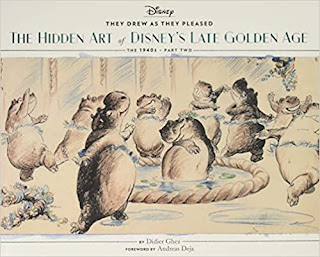
Between Books - They Drew as They Pleased: The Hidden Art of Disney's Late Golden Age The 1940's - Part Two


Book cover showing hippos dancing

Short Version - They Drew as They Pleased by Didier Ghez is really good.  If you like or love Disney animation and books you will want very volume.  With volume three, that summary can continue!

Long Version - They Drew as They Pleased: The Hidden Art of Disney's Late Golden Age The 1940's - Part Two by Didier Ghez is the third volume in this art driven series.  Ghez again features treasures from Disney's story artists.  This volume focuses on members of the short lived Character Model Department in the 1940’s under the leadership of legend Joe Grant  The artists including Jack Miller, Campbell Grant, James Bodrero, and Martin Provensen may be a group that honestly are not familiar with every Disney fan.  But they were a group who contributed significantly to the look and feel of Disney features like Fantasia and animated shorts in the 1940s. 

For me, I really focused on Miller, Grant, Bodrero, and Provensen.  The Character Model Department  was only functional for a few years.  And they were often resented by their animation colleagues for their ability to play and dream.  But the group was made of high-quality artists, many of them finding their way to other commercial avenues after Disney.  And they were extremely close with Grant, Bodrero, and Provensen living together, playing together, and seeming like a real life Three Musketeers.  While there were several projects discussed, I found myself struck with the differences between Fantasia and Victory Through Air Power during World War II.  Fantasia concept art from these artists is true fine art.  But for the air power propaganda film, well there is no concept art in these brilliantly illustrated paintings.  As this Disney passion project bored them with charts and arrows and in some cases drove them one step closer to leaving the studio even joining the war effort.  Leaving the studio is a true theme as it is shocking yet again how short some of these masters’ tenure at Disney was. 

Yes, They Drew as They Pleased: The Hidden Art of Disney's Late Golden Age The 1940's - Part Two is a volume that history loving Disney fans want and need.  Well written and beautifully illustrated it is yet another joyful read. 

This post contains affiliate links, which means that Between Disney receives a percentage of sales purchased through links on this site. 


Friday, August 20, 2021

Between Books - They Drew as They Pleased: The Hidden Art of Disney's Musical Years The 1940's - Part One


Book cover for They Drew as They Pleased: The Hidden Art of Disney's Musical Years the 1940's Part One showing Peter Pan and Wendy captaining a pirate ship painted by David Hall

Short Version - They Drew as They Pleased by Didier Ghez is really good.  If you like or love Disney animation and books you will want very volume.

Long Version - They Drew as They Pleased: The Hidden Art of Disney's Musical Years The 1940's - Part One by Didier Ghez is the second volume in this art driven series.  Ghez again features treasures from Disney's story artists.  The book covers artists that are well known in Kay Nielsen and Retta Scott but also those that Disney fans may not be as familiar with like Walt Scott.  Each chapter includes a brief description of the artist's work and the pages of their art, which are well-framed and often striking to the reader.

Honestly, I do not have a lot to say about this volume.  The artists picked are a great representation of the studio and the films which Disney had in production during a time that Ghez labels a musical era.  Ghez faces some issues straight one such as the status of women in the studio and Walt Disney's views of their contributions.  A theme which is unstated in this volume is short tenures with many of these artists quickly moving on in the time of economic uncertainty as World War II opens and labor changes after the studio strike.  If I had a to pick a criticism, I would have loved to see more of Retta Scott's art for Bambi and less of unfinished Disney projects due to her skill drawing animals.

If you are reading this review you probably like or love Disney books.  Yes, you need a copy of They Drew as They Pleased: The Hidden Art of Disney's Musical Years The 1940's - Part One by Didier Ghez in your library.  There is a pretty good chance you were already thinking about this!  Just let me confirm it for you.  It is an excellent volume with fantastic art that you want in your collection.

This post contains affiliate links, which means that Between Disney receives a percentage of sales purchased through links on this site. 

Tuesday, December 22, 2020

Between Books – They Drew as Pleased: The Hidden Art of Disney’s Golden Age The 1930s


Book cover showing Dwarves from Snow White


I had heard a lot of good things about Didier Ghez’s They Drew as They Pleased series. But I had not pulled the trigger on a copy of this art series due to price and time. But recently the Between Wife purchased me a copy as gift. And if anything has given me joy during this pandemic it appears to be art books.

They Drew as Pleased: The Hidden Art of Disney’s Golden Age The 1930s by Ghez introduces readers to four important early Disney story artists. These artists in the Story Department did not animate or put Disney characters directly on cells. Instead they were the artists that modeled the tone, mood, models and even worked out scenes in their early stages before animators were asked to create the story. They were the draftsmen and draftswomen that created the look and story which then would be turned over to the army of animators, inkers, inbetweeners and other artists who worked directly on screen. The book is fairly simple with four main chapters crafted around one artist from the 1930s. Ghez introduces his readers to the four artists; Albert Hurter, Ferdinand Horvath, Gustaf Tenggren and Bianca Majolie including their educations, pre-Disney careers, Disney highlights and then post-Disney lives. The biographies which run around 10 pages each are then followed by pages and pages of concept art that the artist provided Disney including projects which became films and shorts along with those which were never realized.

Let me be honest, the art is gorgeous. It is presented well and allows one to dive into these story creations. And with the art being the bulk of the pages, it should be and Chronicle Books succeeds. The biography to me were fairly interesting as they showed me some trends among the artists I was not fully familiar with. First, many early Disney artists had European roots and sensibilities, which then had a large impact on his early fairy tale films. Also, while we may thing of animators who stayed on for years, the early story artists appear to have had relativity short careers at the studio. Additionally, I really enjoyed reading about Majolie who had ties to young Walt in Chicago and how she was able to grow into the story artist role as a woman in a very male dominated department.

They Drew as Pleased: The Hidden Art of Disney’s Golden Age The 1930s is likely a must for Disney art history fans. The pages are pleasing, but I personally could use a few additional context captions being more word based. And I have read, even written, history in this short biography format. But some may balk at a $30 price tag for this style of book. For one, I really like it as an addition to the Between Books shelf and will likely add more in the future.

Tuesday, December 8, 2020

Between Books – 2020 Hyperion Historical Alliance Annual


Cover of 2020 Hyperion Historial Alliance Alliance

As someone who has a history degree and been part of history associations, I have some pretty high standards for what content should be from these professional groups.  Then tie in Disney and the contributors who are participating in the Hyperion Historical Alliance, well a fairly high bar is set.  With the “2019Hyperion Historical Alliance Annual”, I found a concern or two.  Would the Alliance’s second annual correct the concerns I had?

In his introduction, Hyperion Historical Alliance President Didier Ghez notes that the first Annual appeared to really focus on production and artists.  And for this volume they attempted to provide a wider array of topics.  I am not sure that they fully hit with this stated goal as five of the six essays are really based on filmed productions and only one theme park based article.  However, I never really noticed the focus on production.  Instead I found myself caught up on an unintentional theme, Disney female pioneers.  Of the six articles, three have a focus on female contributions in Disney history and unearthed to me some unknown interesting Disney figures.  And Ghez’ article on Mickey Mouse productions also adds additional female contributions.  And on a whole I found these articles interesting and engaging. 

The “2020 Hyperion Historical Alliance Annual” consists of six articles.  The first two highlight the contributions of two female creators in the 1930s and 1940s giving an overview of the careers of Betty Smith-Totten and Grace Huntington.  Both articles make it clear these women were trailblazers in numerous areas of their lives and the impact of women at Disney.  “A Preview of Disney’s World” chronicles the Walt Disney World Preview Center, with a focus on staffing and the Center’s impact on promoting the future theme park.  “Wise Dwarfs and Thrifty Pigs” outlines the use of Disney animation to promote Canadian War Bonds during World War II, which really shows the innovative ways Disney reused animation for new purposes.  And finally, “Mickey’s Revivals” discusses the attempts to get Mickey back on the big screen from the 1970s to the recent past. 

One of my complaints of the earlier volume was adapted work that I had seen elsewhere and in multiple forms.  To me these articles were all fresh and new research.  The one that likely worked the least for me was the Mickey article, as it felt like it was the one which could have been written without special access to unpublished documents or interviews.  And it just reminded me that I wish the Hyperion Historical Alliance was less exclusive and a path for those who are interested in Disney history to have more active participation.

And I can guarantee, I will purchase next year’s annual especially after the quality of the articles in the 2020 edition.